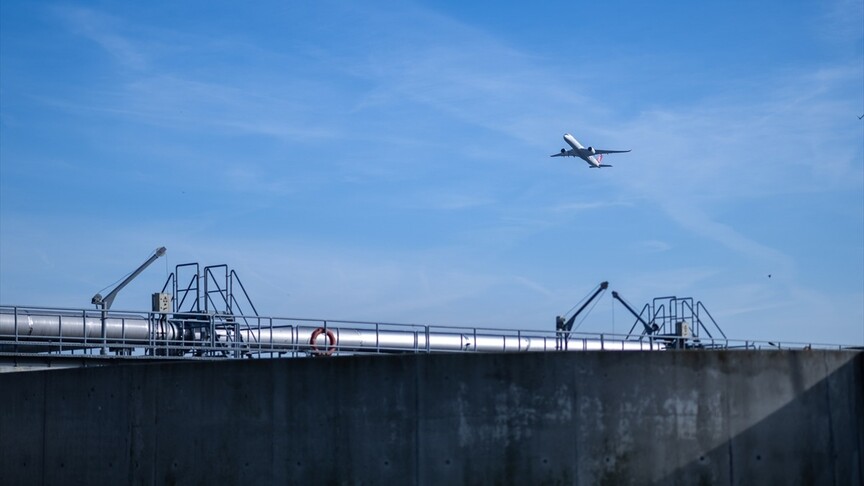
Istanbul Airport, one of the busiest airports in the world, is carrying out projects to use water more efficiently and recover it as passenger and flight traffic grows each year.
The airport operator IGA plans to put a reverse osmosis (RO) facility into operation in the second half of 2027. The plant will add to the airport's existing water recovery capacity and is intended to end its dependence on the municipal water network.
Solar-Powered Airport Targets Water Self-Sufficiency
Istanbul Airport already meets its entire electricity demand from solar energy, with a 240 MW solar power plant. It is now working toward the same goal for water.
IGA put an advanced biological wastewater treatment plant into service on April 7, 2019. The plant was designed to treat wastewater for a settlement of about 90,000 to 100,000 people. Sludge produced during treatment is thickened, dewatered and dried using solar energy.
Reclaimed Water Covers 42 Percent of Consumption
Last year, the airport served 84.4 million passengers and used about 1.067 million cubic meters of reclaimed water. This met 42 percent of its total water consumption. The volume is equal to the annual water use of about 5,000 households. IGA aims to keep the recovery rate at or above 42 percent this year.
Digital monitoring systems track water use. Annual water consumption per passenger fell from 22.6 liters in 2024 to 20.4 liters in 2025.
A Management Approach Based on Reuse
Murat Kerrar, IGA Deputy General Manager for Technical Affairs, told Anadolu Agency (AA) reporters that the airport does not treat water as a throwaway resource. Instead, it plans water use so that water is reused within the system wherever possible.
Kerrar said different areas of the airport require water of different quality, from the terminal and technical facilities to cleaning and landscaped areas. He described three main priorities: reducing consumption and improving efficiency, reducing dependence on the municipal network, and recovering and reusing as much wastewater as possible.
Kerrar said the airport manages the full cycle, including water distribution, quality control, wastewater collection, treatment and preparation for reuse. A water conditioning control laboratory checks the quality of drinking water and of the water used in air conditioning systems.
To reduce consumption at the source, the airport uses sensor-operated taps, low-flow cisterns and efficient equipment, and these systems undergo regular maintenance and efficiency checks.
International Recognition
Kerrar said the airport measures its water performance against international standards. On July 1, 2026, Istanbul Airport became the first airport to earn the Blue Water Efficiency Certificate. In the CDP Water Security Program's 2025 assessment, it received an A score.
Kerrar said the airport views these results as a means to improve data-driven monitoring, risk management and water efficiency, not as ends in themselves.
Seawater Desalination Planned
Kerrar said IGA plans to desalinate seawater for use in its systems by the end of 2027, which would eliminate its dependence on the municipal network.
Hayri Saner Toksöz, IGA Environment and Water Management Manager, said the wastewater treatment plant has a capacity of 15,000 cubic meters. Recovered water is used for garden irrigation and cooling towers.
Toksöz said water stress is considered one of the major risks today. He said the recovery work reduces both the airport's own water risks and its impact on Istanbul's freshwater sources.
Toksöz also said work has started on a facility that could meet all of the airport's water needs from seawater.
Describing the treatment process, Toksöz said wastewater collected across the network passes through screens, then sand and oil separators, then an aeration tank and a settling tank. It then goes through a chlorination tank, sand and activated carbon filters, and advanced treatment units. Finally, it passes through ultrafiltration and reverse osmosis systems.
Toksöz said the resulting water is of a quality well above drinking water standards and close to pure water.