Serbia's long-standing leader Aleksandar Vučić has admitted defeat to a student-led protest movement in snap parliamentary elections.
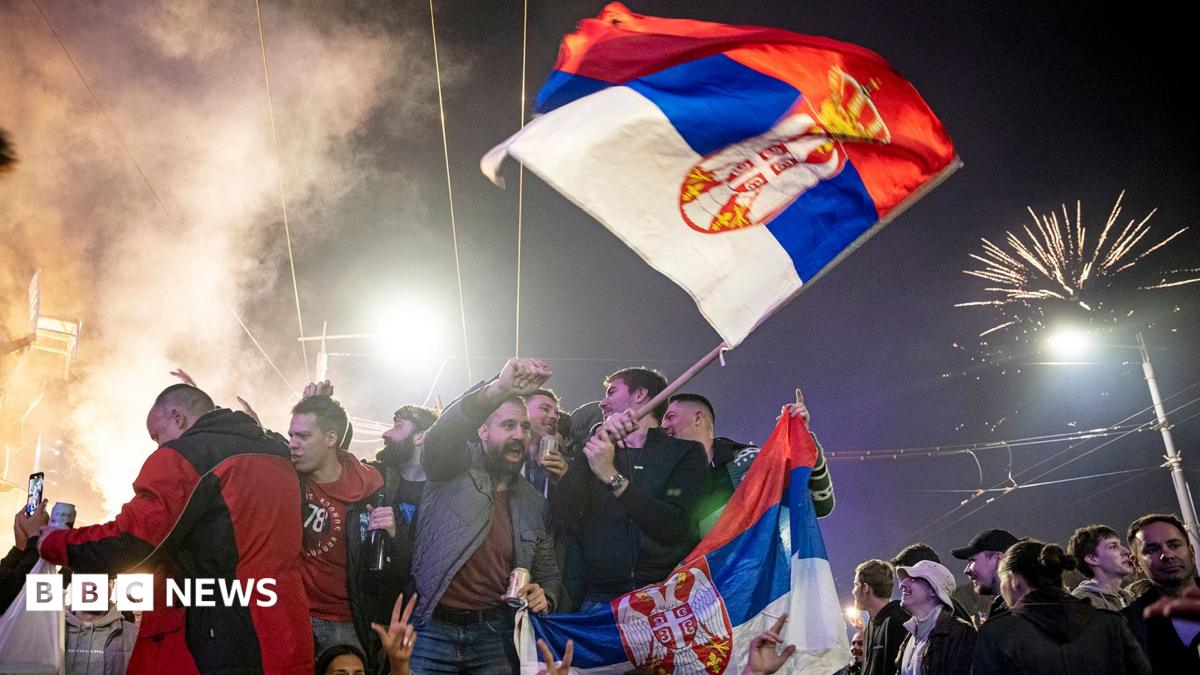
Crowds gathered in the centre of Belgrade, Novi Sad and other cities to celebrate.
The student movement was formed less than two years ago in response to a railway station disaster, which it blamed on corruption and negligence. It contested the election with candidates from across Serbian society.
Vote count
"It is clear we have lost these elections," said Vučić, the right-wing populist leader, as he conceded.
With 96% of polling stations counted, Serbia's election commission said the students had won 2.24 million votes. The former ruling party received 1.67 million.
According to preliminary figures released late on Monday morning, the students won 52.65% of the vote. Vučić's Serbian Progressive Party (SNS) received 39.2%.
Background
Vučić served two terms as president and cannot seek a third. He led the SNS with the aim of returning to the post of prime minister, which he left in 2017.
He called the snap elections after two years of protests. The protests were triggered by the collapse of a canopy in front of Novi Sad station, which killed 16 people.
Reaction
Student List lead candidate Ilija Srdanović told BBC Serbian: "This will be a free state." He said the anti-corruption movement, which attracted anti-government voters across Serbia, hoped to 'free the country from tyranny'.
In Belgrade, people danced in the streets and chanted 'victory'. Cars honked and fireworks were set off. "Serbia is free," one student told the BBC. "It's a miracle."
Student List candidate Radomir Saicic told a celebration crowd that Serbians had shown 'no obstacle was greater than their will', Reuters reported. "No force can forever overpower a people who have decided to take their destiny into their own hands," he said.
Selena Lebovic, who was dancing in the Belgrade streets, said the result was 'really fabulous'. "We are all crying, and what to say. We couldn't believe that it would be so easy," she told Reuters.
Vučić made his announcement at the headquarters of the SNS in Belgrade.
In Novi Sad, the northern city where the student protests began, the centre was crowded. David Vasić, one of those celebrating, told BBC Serbian: "Everything is going to get better now."
Who the students are
The Student List has no obvious leaders, and its members are not used to politics. It fielded candidates for the 250-seat parliament from across society, including doctors, actors, academics and sports personalities.
Nebojša Vladisavljević, professor of political science at the University of Belgrade, said: "This is not an ordinary election victory, this is an avalanche that has wiped out an authoritarian regime and entire political scene."
He said Serbia now has two big political groups. He added that the Student List has 'absolute legitimacy' to govern in the coming years.
Campaign promises
The anti-corruption movement campaigned on a manifesto that included the following pledges:
- Purging officials who broke rules while cracking down on protesters
- Stopping party loyalists from leading public enterprises
- Freeing the public broadcaster from political control
Vučić and the SNS have repeatedly denied corruption.
Vučić backed Serbia's bid to join the European Union. He refused to impose sanctions on Russia over its full-scale invasion of Ukraine. He had pledged to raise pensions and public sector salaries and to increase investment in state healthcare.
International reaction
Kremlin spokesperson Dmitry Peskov praised Vučić's contribution to relations with Russia. He said he hoped 'the new political force' in Belgrade would understand that co-operation with Moscow was in Serbia's interests. "But, as you know, it takes two to tango."
Hungarian Prime Minister Péter Magyar welcomed the defeat. He said he was delighted to hear from the Student List's leaders 'how much strength our victory in April had given them'. Magyar's party ended 16 years of Viktor Orbán's rule. Vučić's SNS had been in power since 2012.
European Commissioner for Enlargement Marta Kos said: "A new chapter can begin for Serbia. The door to the EU is open, and we are ready to move forward together."
Voting abroad and next steps
Long queues formed outside polling stations across Serbia earlier in the day. Similar scenes were reported at booths in countries with large Serbian communities, including Ljubljana in Slovenia, Munich in Germany, and Los Angeles and Chicago in the US. In Paris, Serbian voters waited in line in heavy rain.
The election took place amid high tensions. Police sealed off streets around the Republic Electoral Commission (RIK) in Belgrade.
Attention now turns to who will lead the Student List as prime minister. Presidential elections are due in December. Parliament speaker Ana Brnabić is currently filling the role in a caretaker capacity.