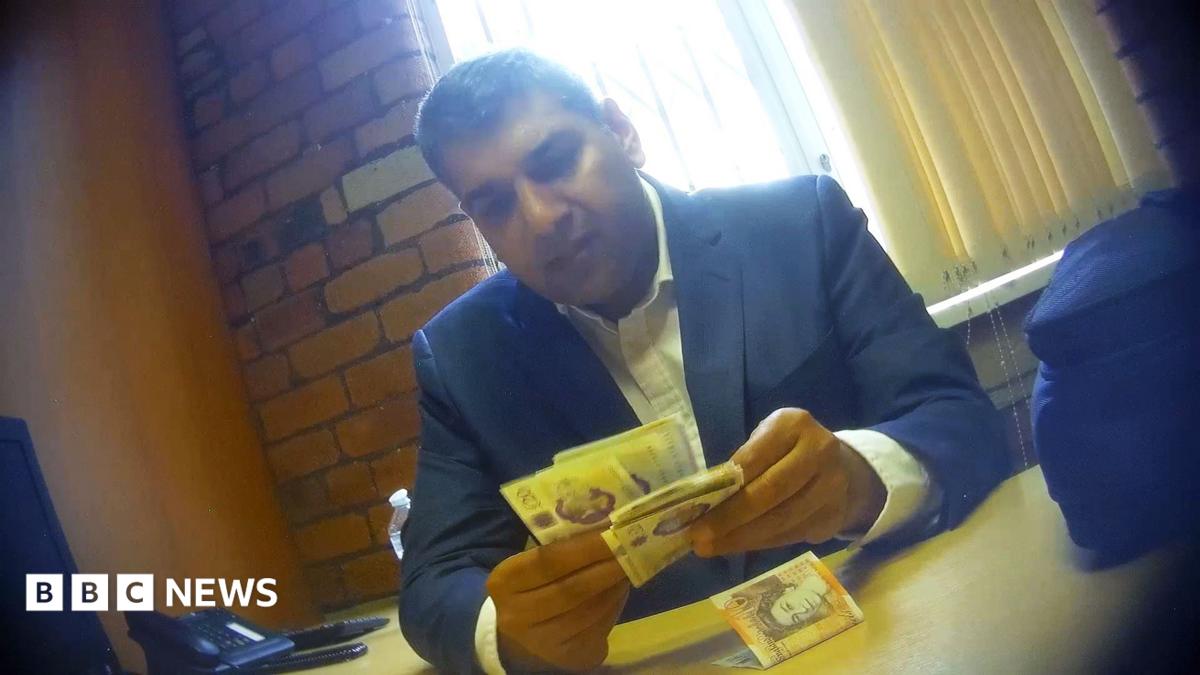
A Bradford solicitor has been secretly filmed by the BBC explaining how he could make a £45,000 illegal-working fine disappear. Mohammad Alias Yousaf, also known as Alias, made the claim to an undercover reporter posing as a mini-mart owner facing a fine for employing an illegal worker.
The undercover call
The solicitor told the potential client he could avoid paying the fine if he could find someone overseas prepared to declare themselves the owner of the mini-mart.
The reporter contacted Alias by phone, claiming to be a business owner who had been fined after immigration officers found a person working illegally at his shop. There was no real shop, worker or fine. The call was recorded.
During the call, Alias said his services would cost 10% of the fine, which in this case would be £4,500, and that he would want the money up front. He explained how liability could be moved to someone outside the UK, if that person could be named as the business owner.
“Do you have anybody’s name who we can use? Anybody who’s gone back to Iraq, gone back to Iran?” he asked. He then gave a hypothetical example: “Say we put forward Karwan, yeah? Then fine come on Karwan’s name. Karwan not here, Karwan in Iraq.”
The BBC said this appeared to describe the use of a “ghost director”, a person paid to put their name on official documents to mask the real owner of a business. A law enforcement official told the BBC that such practices are widespread.
Meeting at his office
The reporter, fitted with a hidden camera, visited Alias’s office in Bradford and handed over £250 as an upfront payment. Alias had originally asked for £500. He counted the notes but did not provide a receipt.
The reporter then called a contact who gave his name as Saman. In fact, Saman was another BBC undercover journalist based in the UK.
According to the BBC, Alias repeatedly asked Saman to confirm that he was the true owner of the business, even though the mini-mart’s ownership was in question. Saman said he was not the owner and had never seen the shop. Alias then said he could not proceed on that basis.
Alias is heard reassuring Saman: “They might say, ‘OK, you have to pay this money.’ We don’t pay the money. That’s the end of it. Case finished.” Asked whether he had handled similar cases, he told Saman he did it “all the time for people who get fines”.
Legal expert’s view
Bryony Rest, a senior immigration lawyer who reviewed the recordings, said it was “quite appalling” that a solicitor would appear to suggest a false name for a business owner. She said Alias’s conduct amounted to “perverting the course of justice” and that he should be struck off.
Rest also noted that late in the meeting, Alias appeared to become suspicious and said, “I can’t advance an untruthful or dishonest... version of events.” She added that Alias himself had first suggested the untruthful version.
Later, Alias sent the reporter messages appearing to withdraw his offer of help. In a further phone call, he said he would not pursue an untruthful claim and would arrange for the £250 to be repaid. The BBC reports that the money has not been returned. Alias says his firm, Liberty Solicitors, has made repeated attempts to return it.
Wider concerns
The investigation grew out of a wider BBC probe into illegal working at some High Street businesses, including mini-marts and barbershops. Alias’s name appeared in social media videos, including on Kurdish Facebook pages, where business owners praised his help with immigration fines. Some of these videos had more than 20,000 views.
Employers who hire a worker with no legal right to work can be fined. In 2024, the maximum penalty for knowingly employing illegal workers rose from £15,000 to £60,000.
Home Office figures obtained by the BBC show 5,755 illegal-working fines were issued between 2021 and 2025, worth a total of £215m. Only £60.5m has been collected. The Home Office says the gap partly reflects appeals, discounts for fast payment and the timing of payments.
In response to the investigation, Home Secretary Shabana Mahmood has announced a review of how such fines are issued and collected. She thanked the BBC “for exposing those who undermine our rules”.
Solicitor’s response
Alias has denied ever advising anyone to put a penalty in the name of a person who was not responsible for a business, or to give false information to the Home Office. He said he never would.
“My work is to challenge penalties lawfully, through the routes Parliament has provided, usually on the basis that the person found was not an employee at all,” Alias told the BBC.
He also said he had told the reporter in writing that he could not advance an untruthful or dishonest case and did not act for him. He told the BBC he had not commissioned, paid for, approved or circulated the social media videos.